
Materials
Bag materials differ in where their fibers come from, how they feel, and the role they play in a finished design. Raffia and paper straw are flexible fibers commonly used across bag surfaces, while rattan and seagrass bring distinct textures and structural qualities. These material names describe what a bag is made from, not a particular weave or shape. Comparing their origins and typical uses makes it easier to recognize the look each one creates.
Raffia
Raffia is a plant fiber taken from the leaves of raffia palms, which grow in tropical regions, especially in Madagascar and parts of Africa. Once prepared for craft use, the strands feel flexible and slightly textured, with a natural variation in width and surface. This pliability makes raffia suitable for bag bodies, panels, and smaller decorative areas where a soft, organic appearance is wanted. A simple raffia tote, for example, may have a gently irregular surface that shows the individual fibers rather than a perfectly smooth finish. The material’s soft hand lets the bag appear relaxed and lightweight, while its visible strands give the surface a matte, natural character. Differences in strand thickness and color can also create subtle variation across a bag without adding a separate print or pattern.
Paper Straw
Paper straw is made from paper fiber formed into narrow strands, cords, or flat strips for bag-making. It often feels dry and crisp, with a more even surface than natural raffia; depending on the form and finish, it can also feel firmer. It is used for bag bodies and panels, including summer styles. A small paper-straw shoulder bag, for example, can have a neat, regular surface that gives the design a clean, structured look.
| Material | Origin | Typical feel | Typical bag use |
|---|---|---|---|
| Raffia | Leaves of raffia palms | Flexible, slightly textured strands | Bag bodies, panels, and details |
| Paper straw | Paper formed into strands or strips | Dry, crisp, and often even | Summer bag bodies and panels |
| Rattan | Climbing palms with cane-like stems | Firm and cane-like | Rigid bodies and selected details |
| Seagrass | Plant fibers from seagrass | Coarse and grassy | Textured bag bodies and panels |
Paper straw is therefore distinct from palm-derived raffia, cane-like rattan, and visibly coarse seagrass, even when all four appear in natural-toned bags.
Rattan
Rattan comes from climbing palms whose long stems provide a cane-like material for craft and furniture work. Compared with pliable raffia strands, rattan feels firmer and more rigid, so it is commonly used where a bag needs a defined, rounded or box-like body. Rattan can also appear in selected bag details rather than across the entire surface. For example, a small rattan handbag may have a firm cane body paired with a separate handle or fabric components. Its smooth, hard stems create a more pronounced, structured appearance than the soft, irregular surface associated with raffia. The material is recognizable by its solid cane feel and the clear lines of its body; it should not be treated as another name for flexible raffia fiber.
Seagrass
Seagrass is a plant fiber used in woven household goods and bags. It has a coarse, grassy feel, with visible strands that are generally less smooth than paper straw and less pliable to the touch than raffia. In bags, seagrass commonly forms a broad body or panel, where its pronounced texture is part of the design. A seagrass market tote, for example, may show thick, uneven-looking fibers across its surface, making the material easy to identify at a glance. Its natural color and rougher texture give the bag a rustic, casual appearance. Unlike rattan’s cane-like firmness, seagrass is recognized by its fibrous, grassy surface; unlike raffia’s softer strands, it usually looks coarser and more substantial.
Techniques
A raffia bag’s surface and shape depend partly on how its strands are joined. Weaving, crochet, braiding and macrame use different methods, so each produces a distinct texture and degree of firmness. Strand width, stitch or knot size, and working tension also change the finished pattern. Recognizing these methods makes it easier to describe the appearance and structure of a bag.
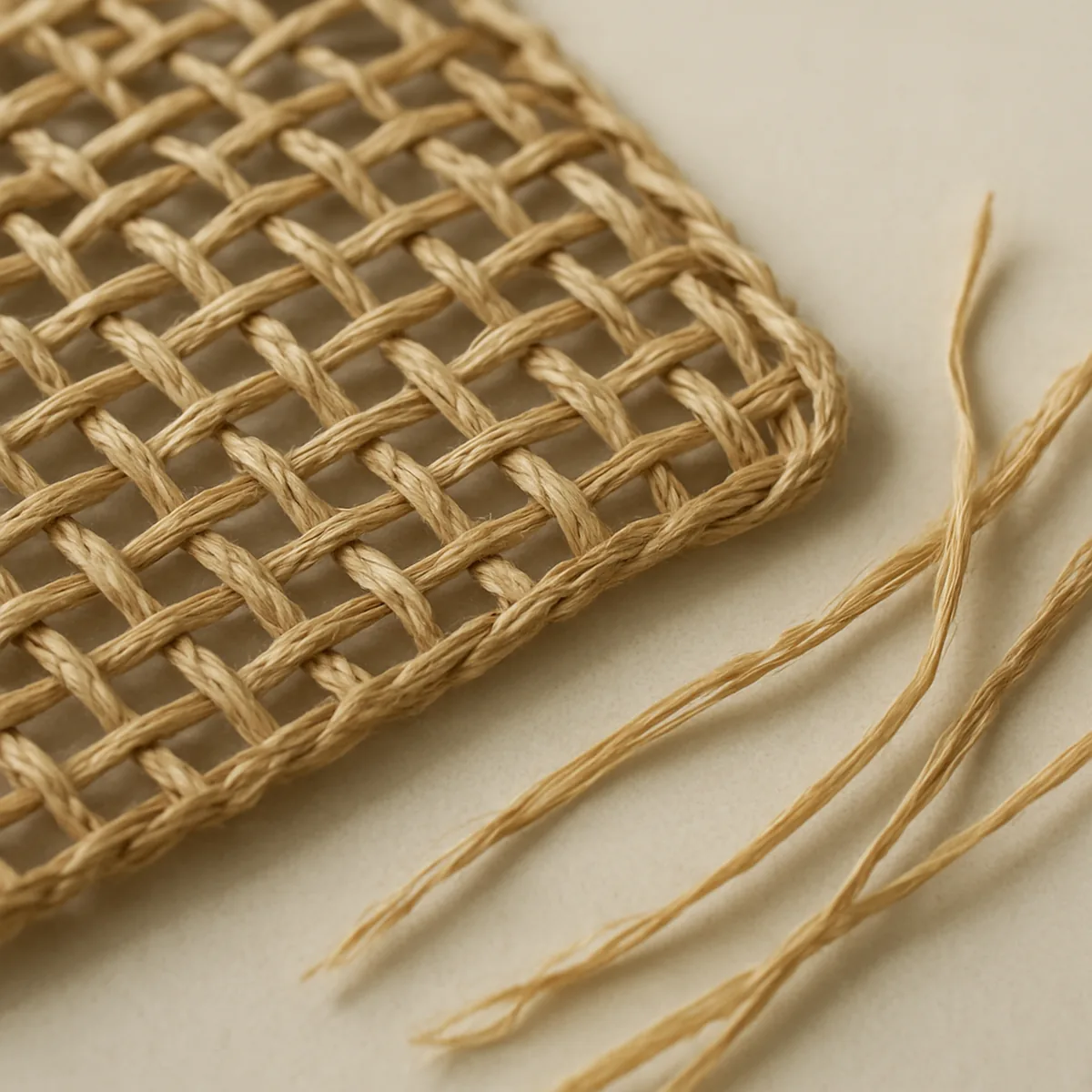
Weaving
Weaving forms a fabric by crossing or interlacing strands, usually in a repeated pattern. In a simple plain weave, one strand passes over and under the next; other arrangements can create diagonal lines, checks or more intricate handwoven raffia patterns. The method produces a connected surface rather than separate loops or knots.
Strand width affects the scale of the pattern: broad strands create a bold, graphic surface, while narrow strands make the crossings appear finer. Weave density matters too. Closely spaced crossings tend to make the fabric look compact and feel firmer; wider spacing reveals more gaps and gives the surface a lighter, more open appearance. Consistent tension helps keep the pattern even across the panel.
For example, a tote with a close, regular over-under weave has a defined grid and a comparatively firm body. A more open weave in the same shape looks airier and shows the crossing strands clearly. These woven raffia techniques describe how the surface is formed, not the fiber itself.
Crochet
Crochet creates fabric by drawing a working strand through loops with a hook. Each new loop is pulled through one or more loops already on the hook, building rows or rounds of connected stitches. Unlike weaving, the fabric develops as a chain of interlinked loops, and stitch names such as chain, single crochet and double crochet refer to different loop formations.
The raised loops give crochet a recognizable, often pebbled texture. Small, closely worked stitches make a denser surface, while larger stitches leave more visible spaces. Crochet is generally more flexible than a tightly woven panel because the loops can shift against one another, although tight tension and compact stitches reduce that movement. The direction and spacing of the stitches can also create stripes, ribs or circular motifs.
For example, a rounded pouch can be crocheted in continuous rounds from its base upward, allowing the stitch pattern to shape the fabric into a curved form. Compact stitches make the pouch look solid; a looser stitch gives it a more open, visibly looped surface.
Braiding
Braiding interlaces three or more strands by repeatedly passing outer strands over or under those beside them. A basic three-strand braid alternates the left and right outer strands across the center, while additional strands can produce a wider, more complex plait. The result is a continuous raised structure with diagonal crossings.
Strand thickness determines the braid’s scale: thick strands form broad ridges, while thin strands create a finer, more detailed texture. Tightness changes both appearance and firmness. A closely pulled braid has compact crossings and holds its shape more readily; a loose braid looks softer and shows deeper gaps between strands. Even tension keeps the braid consistent instead of producing bulges or narrow sections.
For example, a small bag may use a tightly braided panel to create a firm, ridged surface, with the diagonal pattern visible across the front. A looser braid in a similar panel would look more relaxed and pliable. The braid’s thickness and spacing determine whether its texture reads as bold or delicate.
Macrame
Macrame creates fabric or decorative detail by tying cords into repeated knots rather than crossing them in a continuous weave. Square knots and half knots are common building blocks; repeating them in rows or changing their spacing produces geometric patterns. The cords remain distinct, so the knotwork often has a raised, visibly dimensional surface.
Knot patterns control how open or compact the result appears. Closely grouped knots form a denser panel with less space between cords, while widely spaced knots create a net-like structure with larger openings. Tighter knots make the pattern more defined and the panel firmer; looser knotting gives it more movement and a softer outline. Alternating knot types can create diagonal bands, diamonds or fringe-like edges.
For example, a small shoulder bag could have a knotted front panel arranged in rows of square knots, with open gaps forming a diamond motif. A compact pattern gives the panel more visual weight, while spaced knots emphasize its airy geometry. For a firmer, visually compact surface, close weaving or knotting is more suitable; open patterns create a lighter, more relaxed look.
Construction Words
Construction terms describe the parts that hold a bag together and shape how it functions. In a raffia bag, woven panels often meet fabric, leather, or rigid fittings, so the joins matter as much as the visible surface. A lining, base, handle, and hardware each have distinct jobs and different points of strain. Their attachment and finishing details help explain how a bag stands up to repeated carrying, opening, and setting down.
Lining
A lining is the inner layer attached to the inside of a bag, covering the reverse of the outer panels and creating a finished compartment. Cotton, linen, and polyester are common lining fabrics; their weight and weave affect how the interior feels and how readily it snags on keys or other contents. A lining secured along the opening and side seams is less likely to shift or pull away than a loose insert. Neat seam finishing also keeps raw fabric edges from fraying with repeated use.
Pockets may be stitched into the lining, but their seams should be anchored rather than left to carry strain through a thin panel alone. A lining that opens widely with the bag gives clearer access to the interior, while bulky folds at the corners can catch small items. For durability, check that the lining lies smoothly, its seams are even, and its attachment to the outer bag remains secure when the opening is handled.
Base
The base is the lower panel or reinforced support area on which a bag rests. It may be a continuation of the woven body or a separate panel joined around the bottom perimeter. A flat oval or rectangular base helps the bag sit steadily, while its dimensions determine how the lower portion meets the sides. In raffia bag construction, the base may be supported by a denser weave, a fabric layer, or a firm insert; these features help distribute the weight of contents instead of concentrating it on a few strands.
The perimeter seam is a key stress point because it connects the base to the body and bears movement as the bag is lifted. Closely secured stitching or firmly interlaced edges can help prevent gaps from opening under a load. A reinforced underside also takes the rubbing that occurs when a bag is placed on a bench or floor. Examine the base for loose joins, uneven sagging, and worn areas, since damage there can affect the whole bag.
Top Handle
A top handle is the grip attached at the upper edge of a bag, designed for carrying it in one hand. It can be made from woven raffia, leather, fabric, or another material, and its comfort depends on width, thickness, and how it sits in the hand. The handle itself is only part of the construction: the attachment points must transfer the bag’s weight into a strong area of the body or a reinforced facing.
Stitching through a lining alone may loosen when the handle is repeatedly lifted; a sound attachment is anchored through the outer structure or a backing layer. Woven handles need secure ends, while leather tabs typically use stitched or riveted joins. Reinforcement spreads force across more than a small patch of fibers and reduces stress at the top edge. When checking a handle, look for firm joins, even stitching, and any pulling or distortion where it meets the bag; those details affect reliable everyday carrying.
Hardware
Hardware means the functional metal or other rigid fittings on a bag, including clasps, rings, buckles, zippers, and protective feet. A clasp keeps a flap closed, while rings connect a strap or handle; each fitting has a different job and receives force at its attachment points. Hardware may be secured with stitching, rivets, or a backing plate, and the surrounding raffia or fabric should not be the only thin layer holding a heavily loaded fitting.
A smooth, intact finish is less likely to catch on fabric than a fitting with sharp edges, while coating wear can expose the underlying metal and change its appearance. Moving parts such as clasps and zipper sliders should operate without catching; repeated force on a stiff or misaligned closure can strain its surrounding seam. Feet take abrasion when a bag is set down, but only if they are firmly fixed. For daily wear, check fittings and joins alongside the lining, base, and handle: secure construction helps the whole bag withstand routine lifting and setting down.
Choosing by Material, Structure and Use
A bag’s practical performance depends on more than its appearance: the material, construction and intended contents all affect how it carries and holds up. Compare the space you need with the opening, interior shape and handle position. Consider whether a flexible or more structured form better suits the items carried most often. The right choice depends on use, including how often the bag may encounter damp conditions.
Capacity and Intended Contents
Judge capacity by the objects that need to fit, not by the bag’s outer dimensions alone. Check access, internal space and carrying comfort together.
- Measure the opening at its narrowest point; a wide interior is of little use if a book, tablet or folded garment cannot pass through.
- Estimate interior volume from the usable length, width and depth, allowing room for items to settle rather than filling every corner tightly.
- Check handle clearance with the bag on a shoulder or in hand; bulky contents can reduce usable space and make a short drop awkward.
- Consider item shape and weight distribution: flat documents need a broad, stable area, while small essentials benefit from a compartment or pouch.
Choose a more structured body when contents need orderly support; if carrying soft, light items is the priority, a flexible shape may be sufficient.
Shape Retention
How well a bag keeps its outline depends on the combined effect of its fibers, surface construction and support. Greater firmness can preserve a defined profile, while flexibility makes a bag easier to compress or store.
- Stiffer fibers generally resist slumping better than soft, pliable ones, although stiffness alone does not prevent distortion under uneven weight.
- A dense weave or closely worked stitch pattern usually creates a firmer surface than a loose construction, which can flex more readily.
- A reinforced base helps support concentrated contents and reduce sagging; its benefit depends on how evenly the load sits across that area.
- A fitted lining can add support, while a heavy or off-centre load may still pull the sides out of shape during use.
For a defined silhouette, choose a denser structure with base support; if compact storage and softness matter more, accept a more flexible form.
Exposure to Moisture
Moisture tolerance varies with fiber type and the way the bag is assembled, so consider the conditions it will encounter. A brief splash is different from carrying a bag through sustained dampness.
- For occasional light splashes, the surface may be dried promptly; avoid assuming that a natural or synthetic fiber is waterproof.
- Sustained dampness can affect fibers, dyes, seams or attached trims, particularly when moisture remains trapped inside a lined bag.
- After exposure, empty the bag and let it air-dry in a ventilated place, away from direct heat that could make fibers brittle or distort its shape.
- Construction matters: dense surfaces and linings may slow airflow, while open structures can dry more readily but offer less protection to contents.
If use is limited to dry outings with occasional splashes, a natural-fiber bag may suit; for frequent damp conditions, choose a more moisture-tolerant material and construction.